Tamil Technicians – C Programming Course · Lesson 1
What is Programming & Why C is Important? (C Programming in Tamil for Beginners)
Before we write our first C program, we must clearly understand two things: what is programming and why the C language is so important. This lesson is specially written for Tamil-speaking beginners and technicians who are touching programming for the first time.
What Is Programming? Simple Explanation for Beginners
In simple words, programming means giving clear step-by-step instructions to a computer so that it can do some useful work for us.
Just like we give instructions to a helper: “go to the shop → buy 1kg sugar → bring the bill → come back home”, in programming we give instructions to the computer: “read input → calculate → show the result”.
Programming = Instructions + Logic + Order. If the instructions are correct and in the right order, the computer will give correct output.
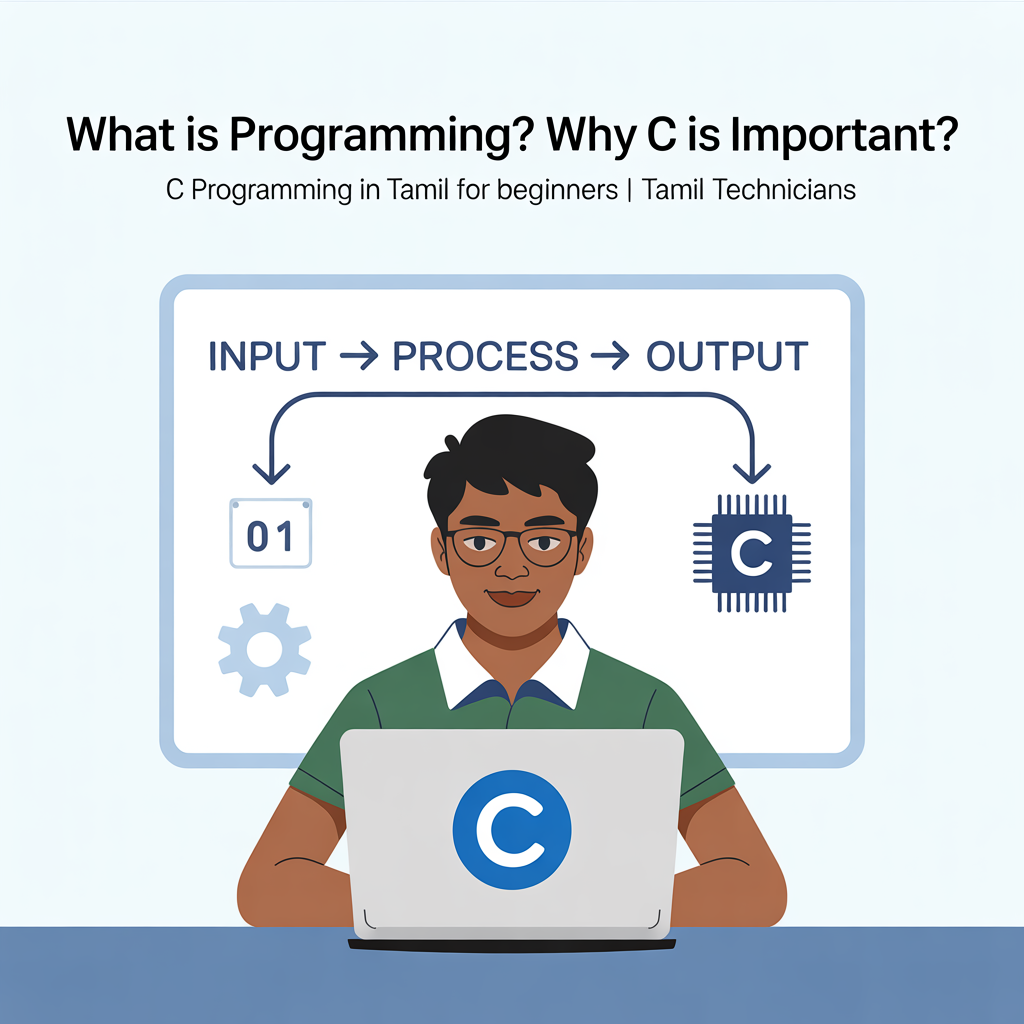
3 Key Parts of Any Program
- Input: What data we give to the program (numbers, text, sensor values, etc.).
- Process: The logic or formula – how the data is calculated or transformed.
- Output: The final result shown on screen, stored in a file, or sent to a device.
Example: A simple electric bill calculator program might:
- Ask for number of units (input).
- Apply tariff rate and calculate total (process).
- Show the amount to pay (output).
Where Do We See Programming in Daily Life?
Even if we don’t see the code, programs are running everywhere around us:
- Mobile apps – WhatsApp, YouTube, UPI apps.
- Smart TVs, set-top boxes, remote controls.
- Inverters, stabilizers, solar controllers, PLCs.
- ATMs, billing machines, weighing scales.
- Industrial machines and robots.
For technicians, this is very important: whenever you see a display, menu, automatic operation, time delay, or sensor-based control, there is some program running inside a chip.
What Is a Programming Language?
A computer only understands binary (0s and 1s). But writing full programs in 0 and 1 is impossible for humans. So we use programming languages to write instructions in a more readable form.
Low-Level vs High-Level
- Low-level – close to machine language (assembly). Very fast but hard to write.
- High-level – closer to English (C, C++, Java, Python, etc.). Easier to write and learn.
Compiled vs Interpreted
- Compiled languages – code is converted to machine code at once (C, C++).
- Interpreted languages – code is run line by line (Python, JavaScript).
C is a high-level, compiled language that is still very close to the hardware. That is why it is so popular in system programming and embedded devices.
Why Is C Language So Important?
Many programmers call C the “mother of programming languages”, because several modern languages are directly or indirectly based on C’s concepts and syntax.
1. C Teaches Core Concepts Clearly
In C, you will directly work with memory, data types, pointers, and structures. These topics give a real understanding of how the computer actually works inside. Once you learn C properly, you will not be afraid of any other language.
2. C Is Very Fast and Efficient
C programs compile to native machine code. This means:
- Faster execution – suitable for real-time and performance-critical systems.
- Better control over memory usage – important in small microcontrollers.
- Less overhead compared to many modern high-level languages.
3. C Is Used in Operating Systems & Embedded Systems
Many critical components are written in C:
- UNIX, Linux kernels and many OS utilities.
- Drivers for hardware devices.
- Firmware of microcontrollers and embedded systems.
- Parts of databases, compilers, and interpreters.
For Tamil technicians working with electronics, panels, PLCs, and embedded boards, understanding C is a big advantage.
4. Easy to Move to Other Languages
After C, moving to C++ (object-oriented), Java, C#, or even understanding Python becomes much easier because:
- Basic syntax (if, else, loops, operators) is very similar.
- Thinking style (variables, functions, control flow) is the same.
- You already understand memory and data structures from C.
C vs Other Popular Languages (For Beginners)
Many beginners ask: “Should I start with Python or C?” – both are good, but a strong foundation in C gives long-term benefits, especially for technical fields.
| Language | Good For | Learning Style |
|---|---|---|
| C | Embedded, systems, OS, performance-critical apps. | Teaches low-level concepts, powerful but slightly more challenging. |
| Python | Automation, data processing, beginner-friendly scripts. | Easy to start, but hides many low-level details. |
| Java | Enterprise apps, Android (older stack), backend. | More heavy syntax, object-oriented from day one. |
From Real Life Steps to C Code – A Simple Example
Imagine you want a program to calculate the total cost of 3 items. First think in normal steps:
- Read price of item 1, item 2, item 3.
- Add all three prices.
- Show the total.
Now look at a simple C version of this logic:
#include <stdio.h>

int main() {
    float a, b, c, total;

    printf("Enter 3 item prices: ");
    scanf("%f %f %f", &a, &b, &c);

    total = a + b + c;

    printf("Total amount = %.2f\\n", total);

    return 0;
}
Don’t worry if you don’t understand everything yet. In upcoming lessons we will break this program into very small pieces and explain each line in Tamil-friendly style.
Mindset for Learning Programming (Specially for Technicians)
Many technicians think, “Programming-na romba kashtam, maths romba thevai”. Actually, you mainly need:
- Patience to read error messages and fix them.
- Willingness to practice small examples daily.
- Interest to understand “why this works like this?”.
If you already do fault finding in circuits, measure voltages, check continuity, and trace wiring, then your brain is already trained for logical thinking. Programming is just one more tool in your toolkit.
Suggested Featured Image for This Lesson
You can use an illustration similar to the intro post, with the following concept:
- A Tamil technician standing in front of a whiteboard or monitor.
- On the board, three icons labelled “Input”, “Process”, “Output”.
- On the laptop screen, a big letter C.
- Soft light background, clean flat style, matching your Tamil Technicians branding.
- Text overlay at the top: “What is Programming? Why C is Important?”
FAQ: Programming & C Language for Tamil Beginners
1. I don’t know any coding. Can I start directly with C?
Yes. This course is designed assuming zero background. We will start with very basic concepts and slowly build your confidence with simple examples and exercises.
2. Is C language only for computer science students?
No. C is very useful for electronics, electrical, instrumentation, and mechanical technicians who want to work with microcontrollers, automation, or industrial machines.
3. Do I need strong maths to learn C?
Only school-level maths is more than enough to start. Basic arithmetic and logical thinking will take you a long way in programming.
4. How long will it take to become comfortable with C?
If you practice regularly (even 30–45 minutes per day), in a few weeks you can write small useful programs: calculators, converters, simple billing, and data logging logic.