Audio Amplifier Repair Training – Repair Guide & Troubleshooting Tips
Common Audio Amplifier Problems and How to Fix Them
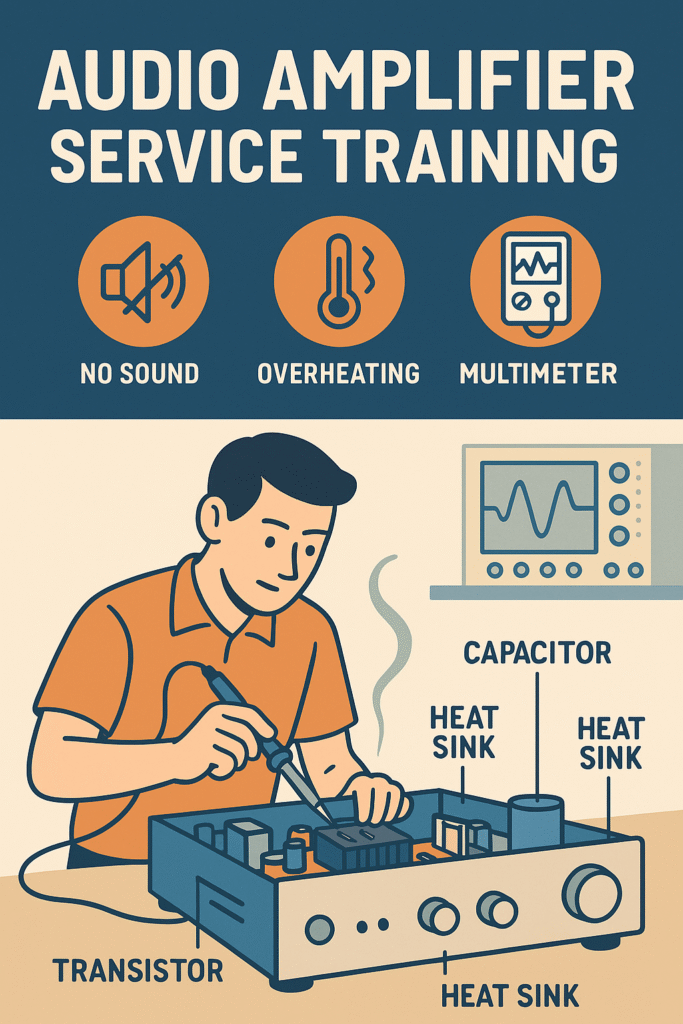
No Sound from the Amplifier – Step-by-Step Troubleshooting
Overheating Issue – Causes & Solutions
How to Test an Amplifier with a Multimeter
# Audio Amplifier Repair Training: A Beginner’s Guide
Introduction :
Audio amplifiers are essential components in sound systems, used to boost weak audio signals into powerful outputs. In this guide, we will explore the fundamentals of audio amplifier servicing, covering troubleshooting, repair techniques, and essential tools required for the job.
Understanding Audio Amplifiers
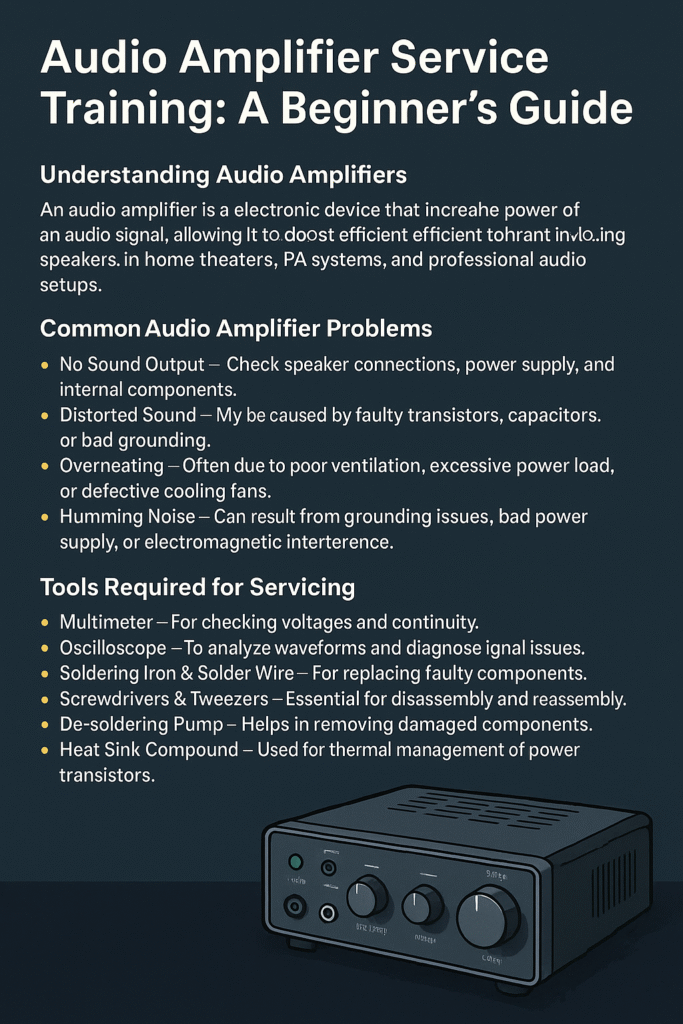
An audio amplifier is an electronic device that increases the power of an audio signal, allowing it to drive speakers efficiently. Amplifiers are found in various applications such as home theaters, PA systems, and professional audio setups.
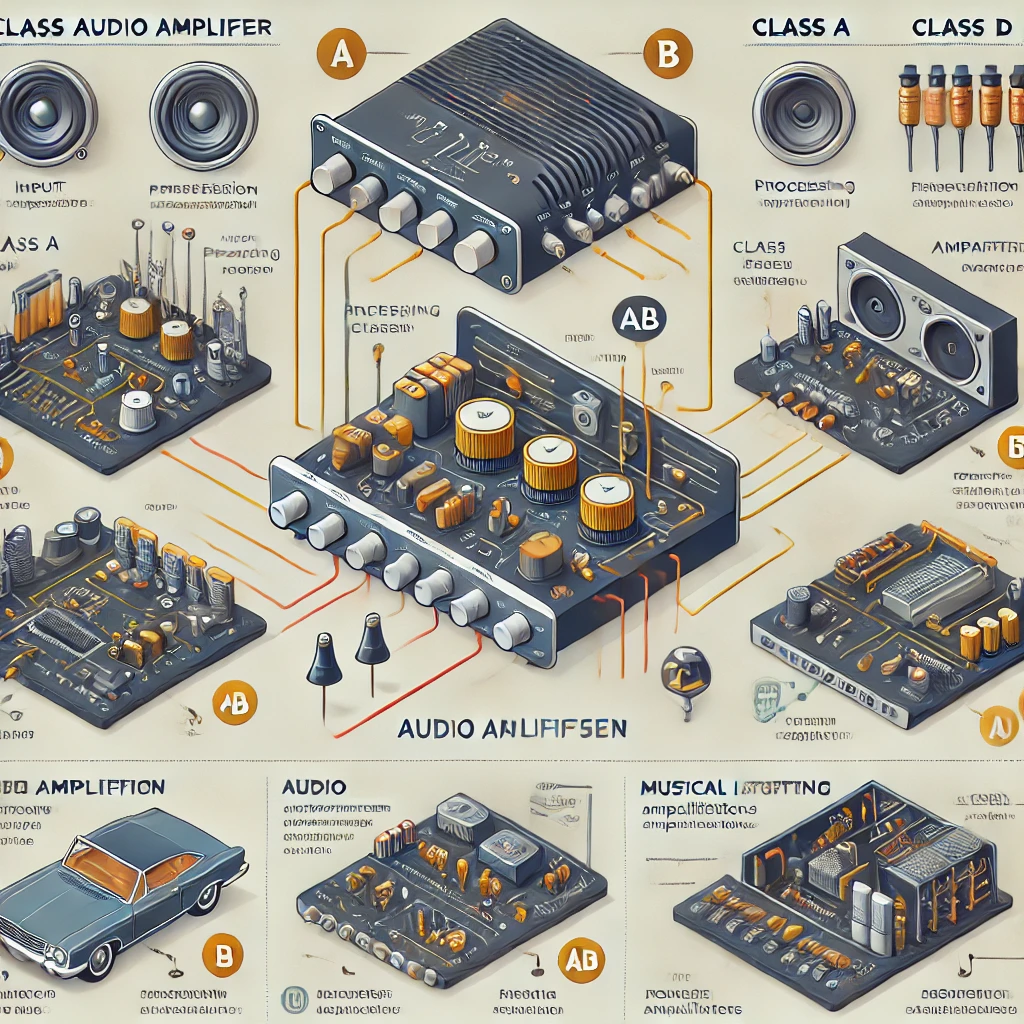
Types of Audio Amplifiers:
- Class A Amplifiers – High-quality sound but less efficient.
- Class B Amplifiers – More efficient but may introduce distortion.
- Class AB Amplifiers – A mix of Class A and B, balancing efficiency and sound quality.
- Class D Amplifiers – Highly efficient digital amplifiers used in modern sound systems.
Common Audio Amplifier Problems
When servicing an audio amplifier, common issues include:
- No Sound Output – Check speaker connections, power supply, and internal components.
- Distorted Sound – May be caused by faulty transistors, capacitors, or bad grounding.
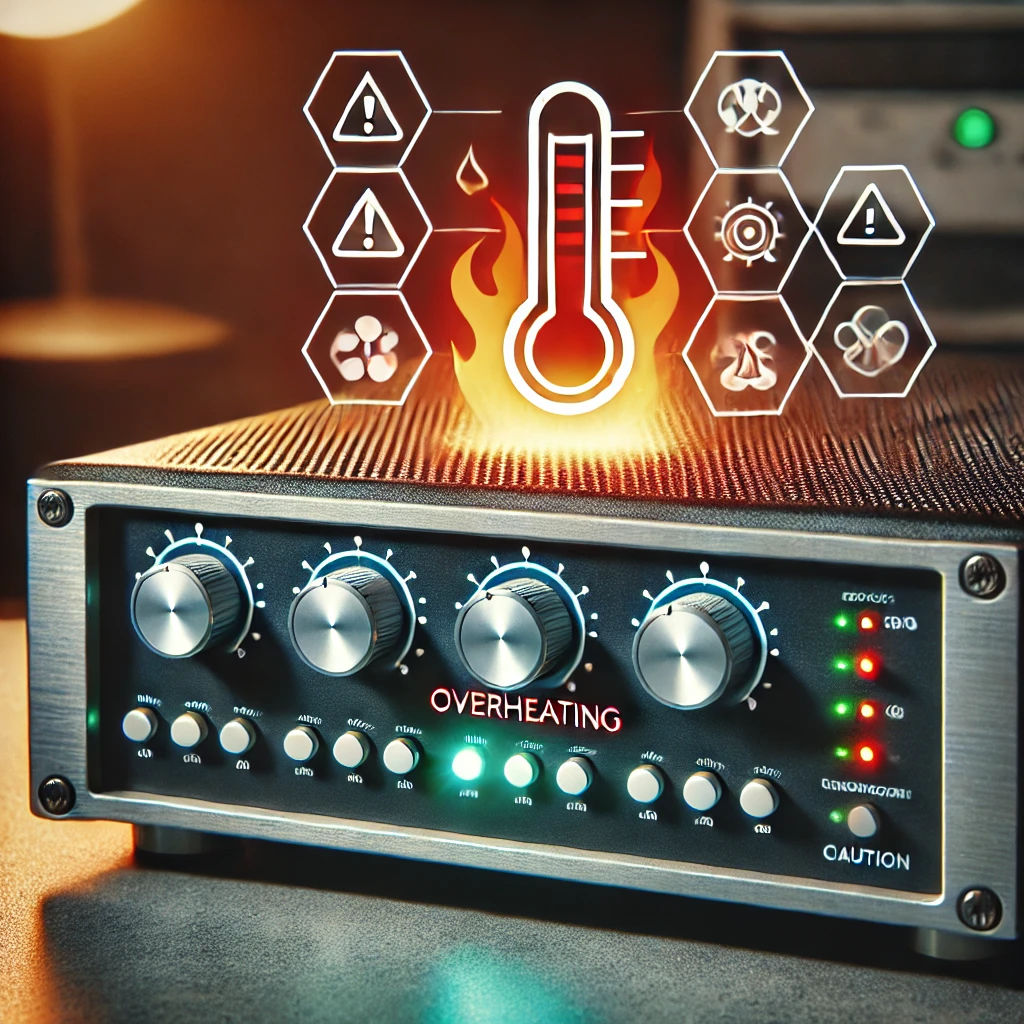
- Overheating – Often due to poor ventilation, excessive power load, or defective cooling fans.
- Humming Noise – Can result from grounding issues, bad power supply, or electromagnetic interference.
Tools Required for Servicing
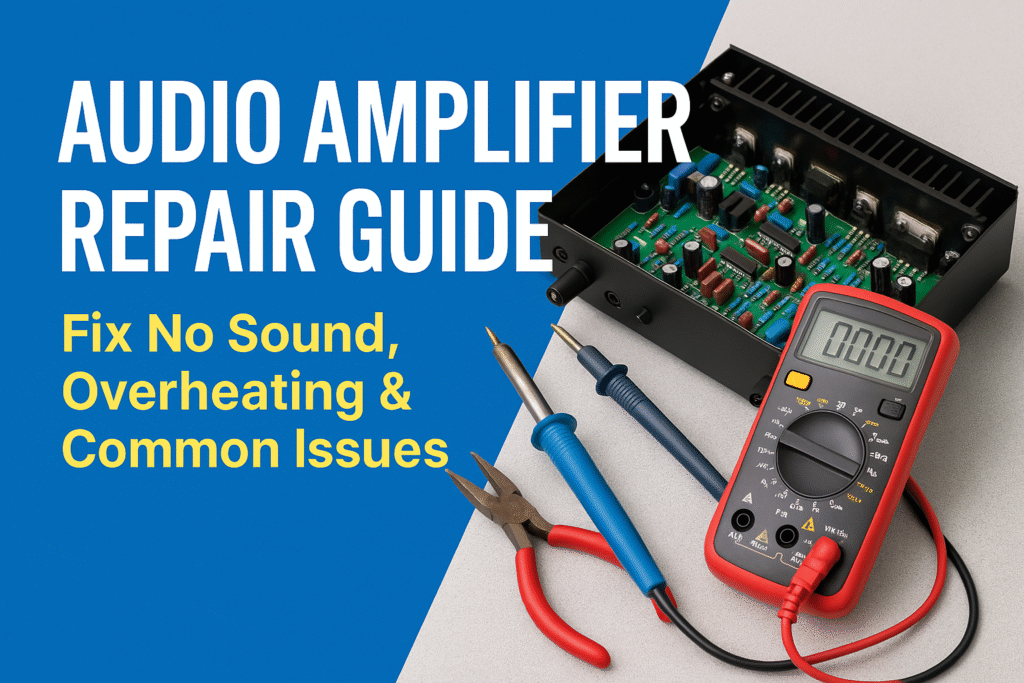
To Audio Amplifier Repair and service audio amplifiers effectively, you need the right tools:
- Multimeter – For checking voltages and continuity.
- Oscilloscope – To analyze waveforms and diagnose signal issues.
- Soldering Iron & Solder Wire – For replacing faulty components.
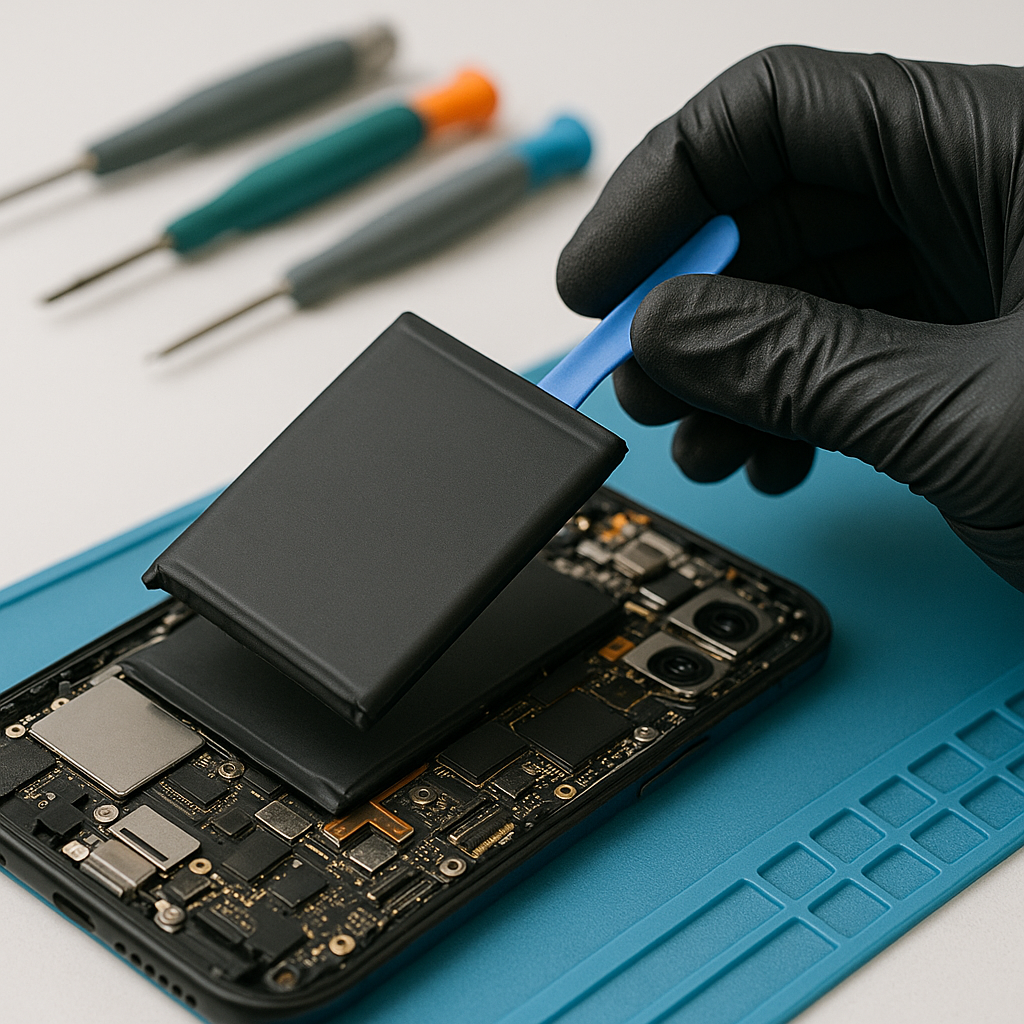
- Screwdrivers & Tweezers – Essential for disassembly and reassembly.
- De-soldering Pump – Helps in removing damaged components.
- Heat Sink Compound – Used for thermal management of power transistors.
Step-by-Step Repair Process
Step 1: Visual Inspection
- Check for burnt components, broken solder joints, or damaged wiring.
- Ensure the amplifier is receiving proper power input.
Step 2: Testing Components
- Use a multimeter to test fuses, resistors, and capacitors.
- Check for faulty transistors or ICs using an oscilloscope.
Step 3: Circuit Tracing
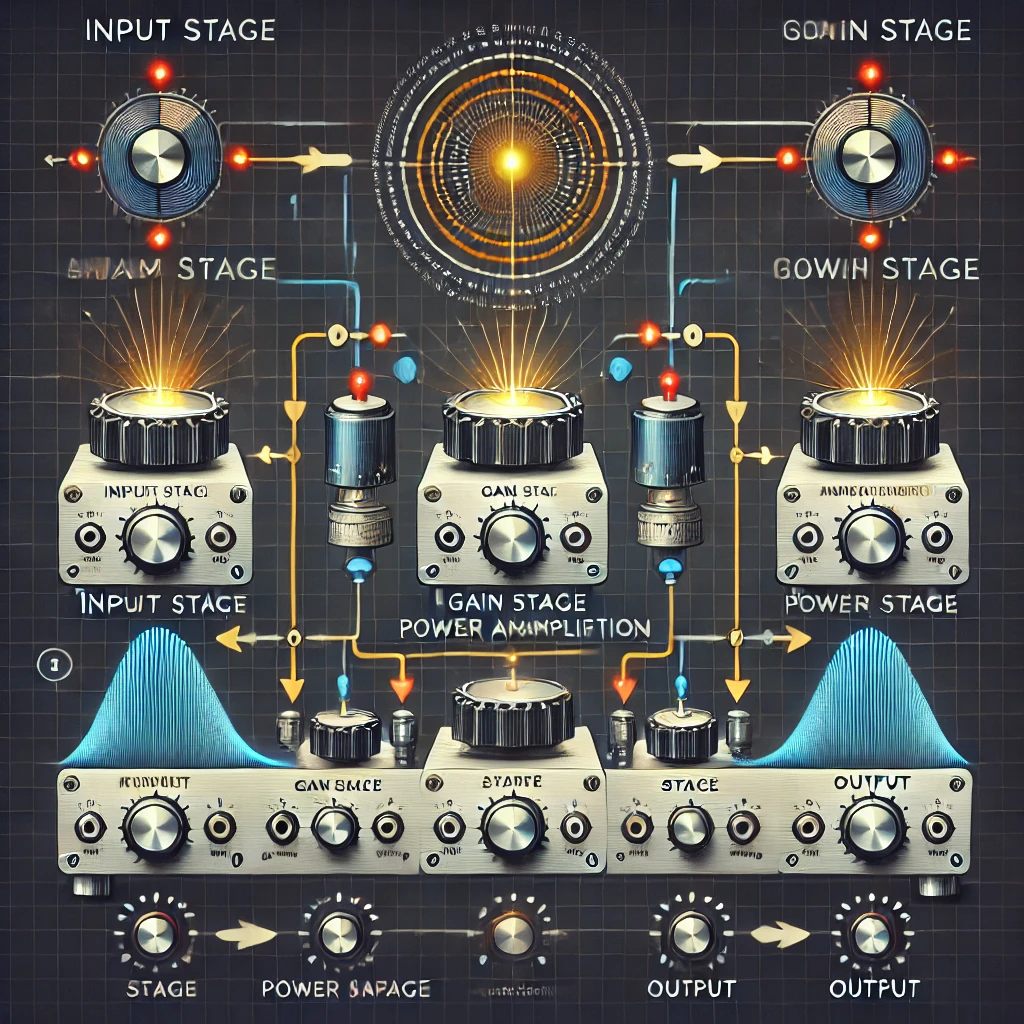
- Follow the signal flow using the amplifier’s circuit diagram.
- Identify the faulty section and replace defective parts.
Step 4: Soldering & Component Replacement
- Carefully de-solder damaged parts and install new ones.
- Ensure proper heat dissipation by applying heat sink compound where needed.
Step 5: Final Testing & Calibration
- Power on the amplifier and test it with a speaker.
- Adjust gain, bass, and treble settings to check functionality.
- Monitor temperature and sound output for stability.
Maintenance Tips for Audio Amplifiers
To prolong the life of an audio amplifier:
- Keep it dust-free and ensure proper ventilation.
- Avoid overloading speakers beyond the amplifier’s capacity.
- Regularly inspect power connections and grounding.
- Use a surge protector to prevent damage from voltage spikes.
Conclusion
Mastering Audio Amplifier Repair requires a good understanding of circuitry, troubleshooting techniques, and the right tools. By following these guidelines, you can efficiently diagnose and repair common amplifier problems. Whether you’re a beginner or an experienced technician, continuous learning and practice will make you proficient in Audio Amplifier Repair servicing.
Would you like more in-depth guides on specific amplifier types or repairs? Let us know in the comments!
Tools Link’s
- UNI-T UT33D+ Reliable Digital Multimeter, Palm-sized, with non-contact voltage detection, for the field engineers
- DZK soldering iron kit set soldering kit Temperature Adjustable soldering iron station 60 watt original power tools home tools tool kit for home
Frequently Asked Questions (FAQ)
Q: How do I fix an amplifier with no sound?
A: First, check the power supply and connections. If everything is fine, inspect the transistors and capacitors for damage.
Q: What tools do I need for amplifier repair?
A: You need a multimeter, soldering iron, oscilloscope, and circuit diagrams.
Q: Why is my amplifier overheating?
A: Overheating can be caused by poor ventilation, faulty transistors, or excessive power supply voltage.
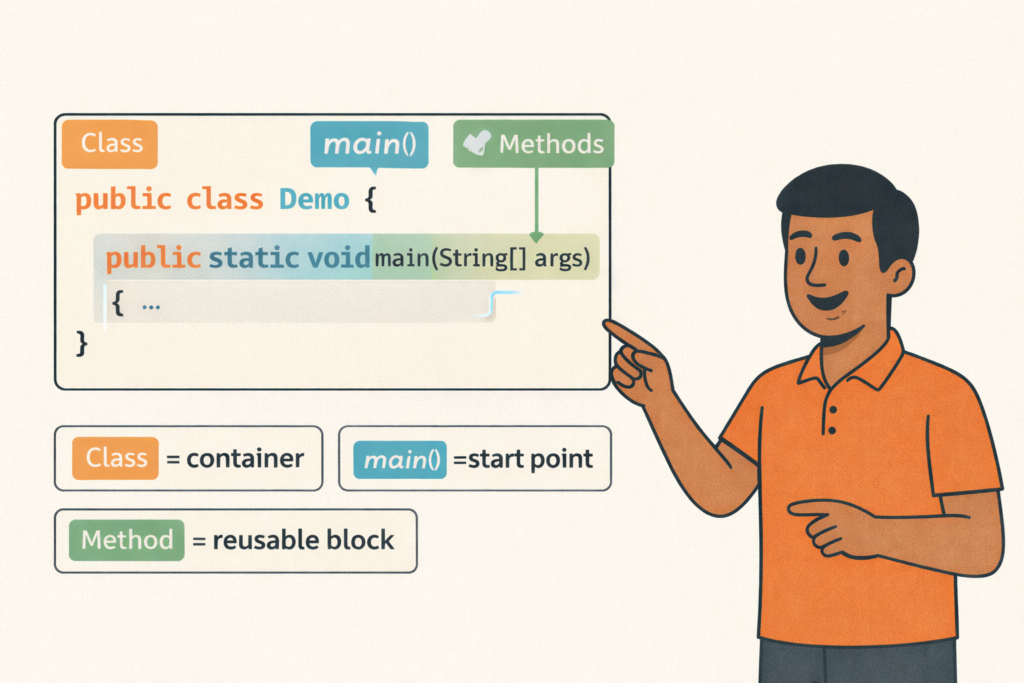
Java Program Structure (Class, main, Methods)– Full Beginner Explanation
Java Program Structure (Class, main, Methods) – Beginner Guide | Tamil Technicians TT Tamil Technicians…

Install JDK + VS Code/IntelliJ Setup+ Your First Java Program (Windows)
Install JDK + VS Code/IntelliJ Setup + First Java Program (Windows) | Tamil Technicians TT…
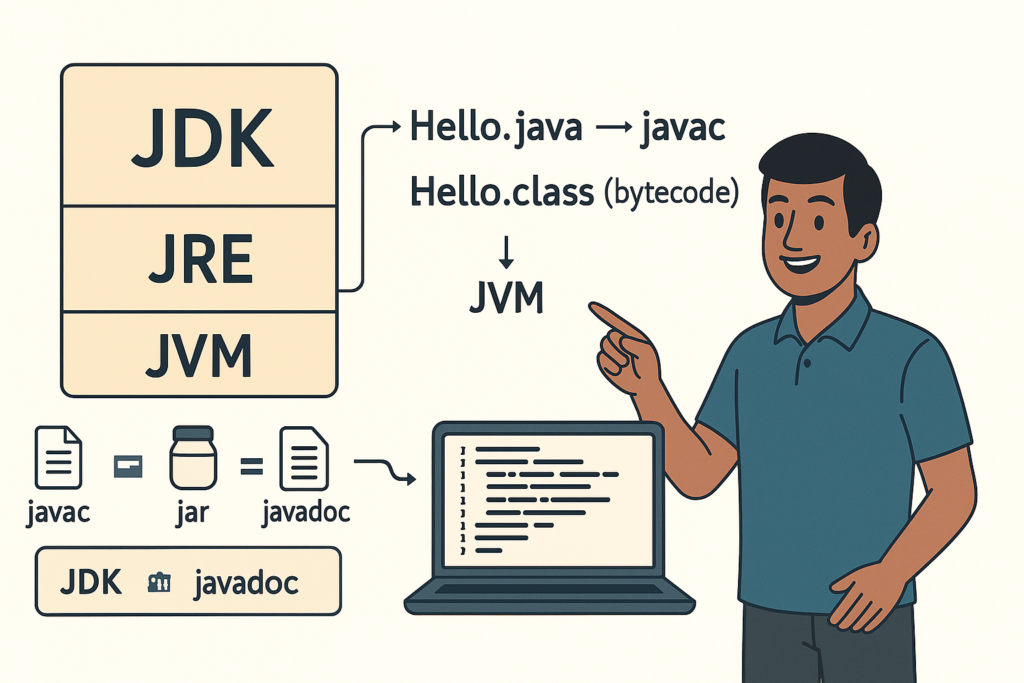
JDK vs JRE vs JVM – Easy Explanation(Compile & Run Flow for Beginners)
JDK vs JRE vs JVM – Easy Explanation (Beginner Guide) | Tamil Technicians TT Tamil…
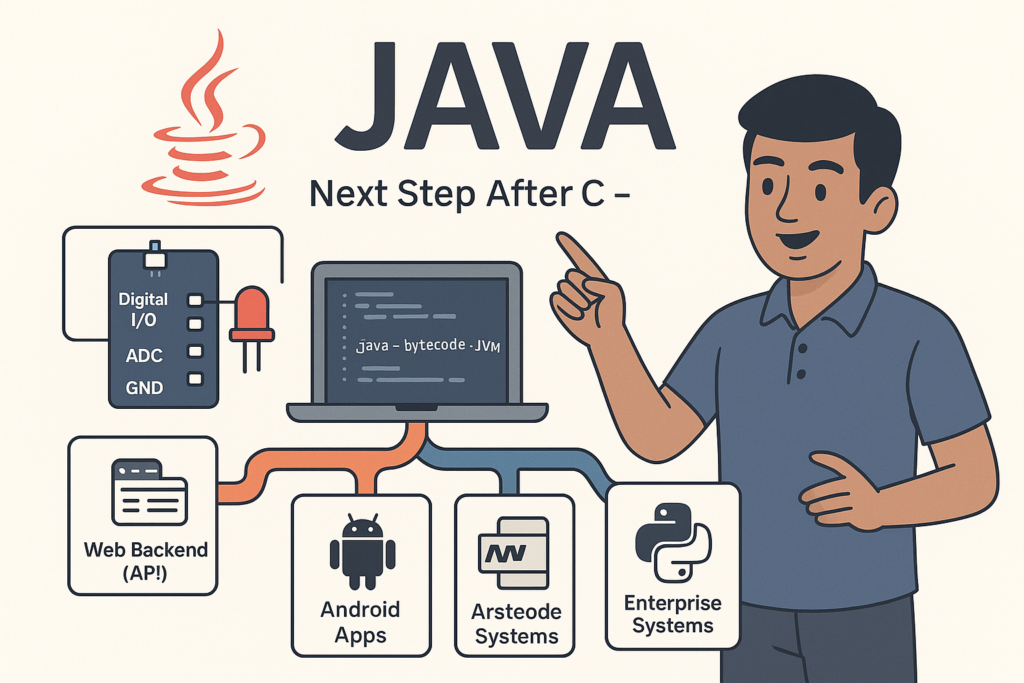
Java Introduction & Where Java is Used(Apps, Web, Banking, Android)
Java Introduction & Where Java is Used (Apps, Web, Banking, Android) | Tamil Technicians TT…
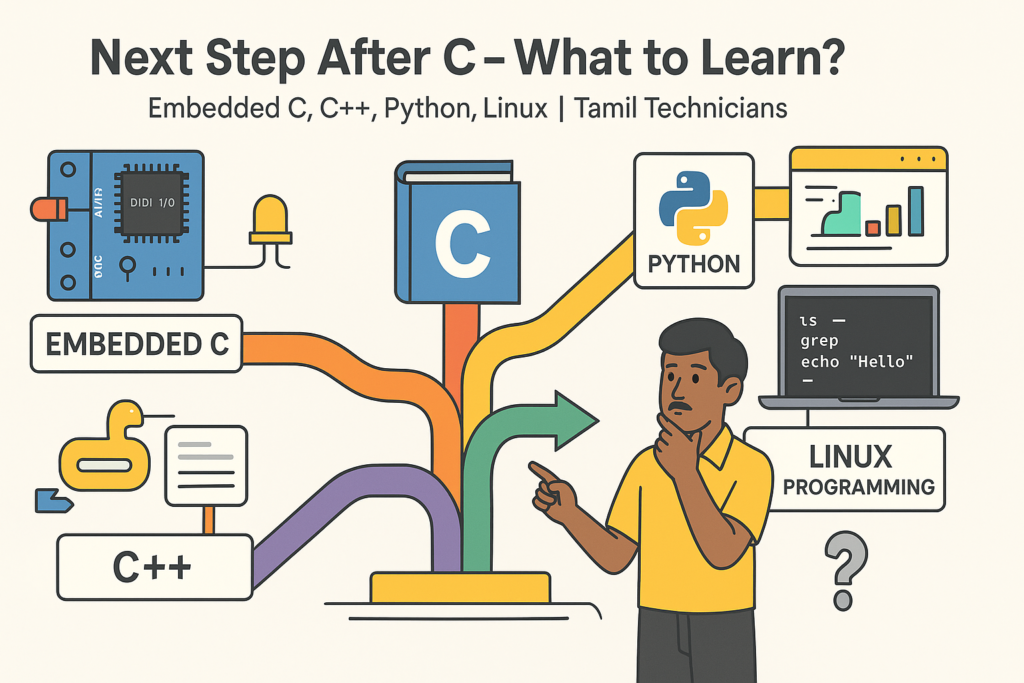
Next Step After C – What to Learn? (Embedded C, C++, Python, Linux Programming)
Next Step After C – What to Learn? (Embedded C, C++, Python, Linux Programming) |…
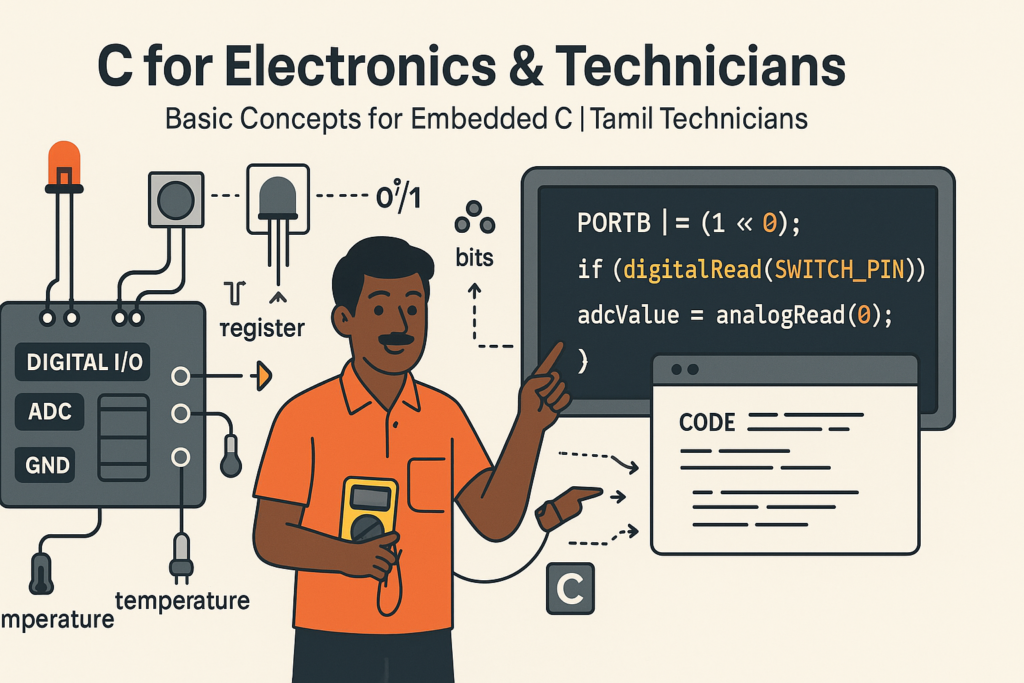
C for Electronics & Technicians – Basic Concepts for Embedded C
C for Electronics & Technicians – Basic Concepts for Embedded C | Tamil Technicians Tamil…
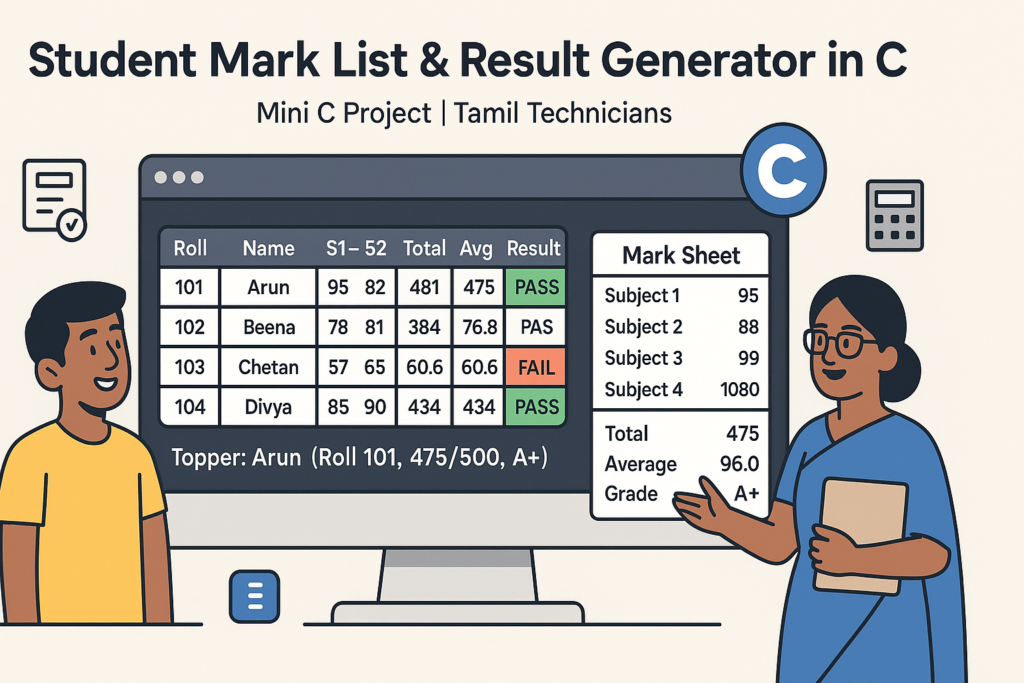
Mini C Project – Student Mark List & Result Generator in C (Console Project)
Mini C Project – Student Mark List & Result Generator in C (Console Project) |…
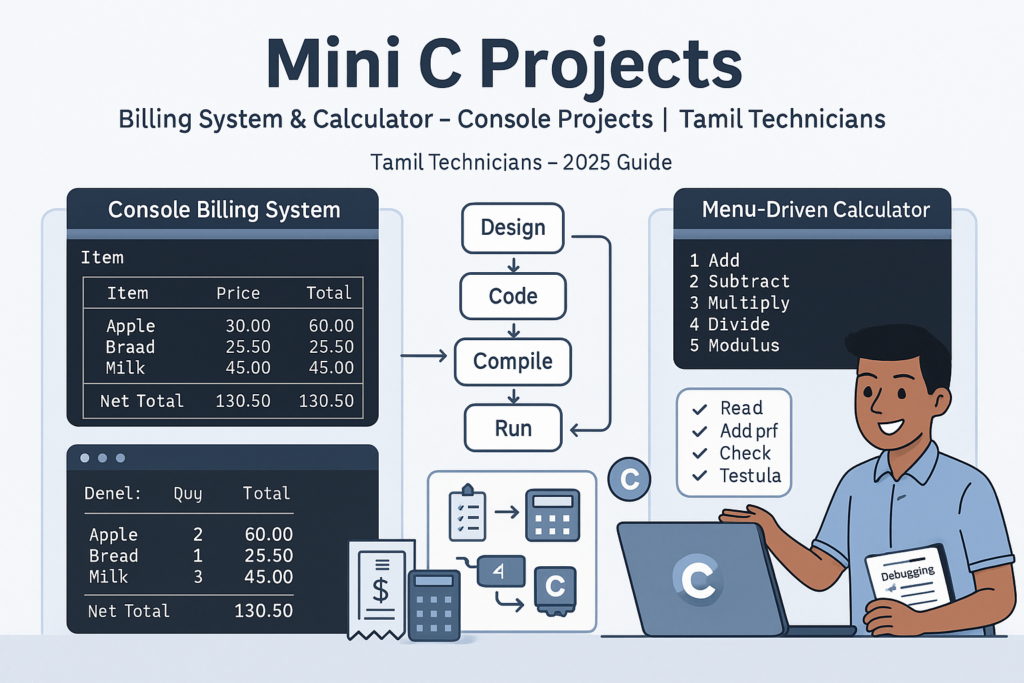
Mini C Projects – Simple Billing System & Calculator in C (Console Projects)
Mini C Projects – Simple Billing System & Calculator in C (Console Projects) | Tamil…
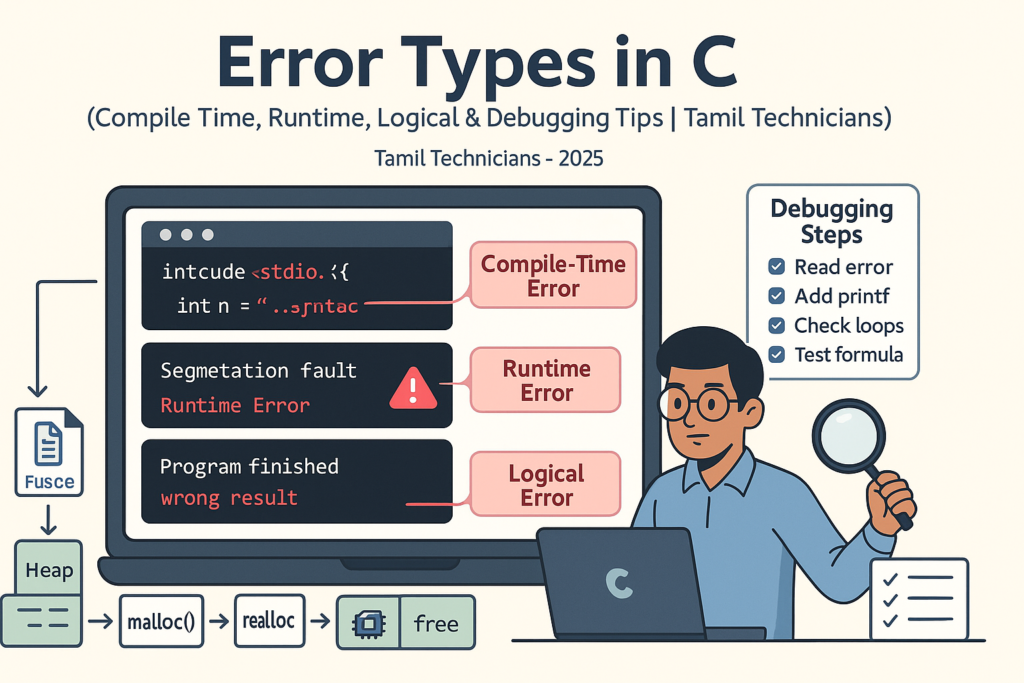
Error Types in C – Compile Time, Runtime, Logical Errors & Debugging Tips 2025
Error Types in C – Compile Time, Runtime, Logical Errors & Debugging Tips | Tamil…
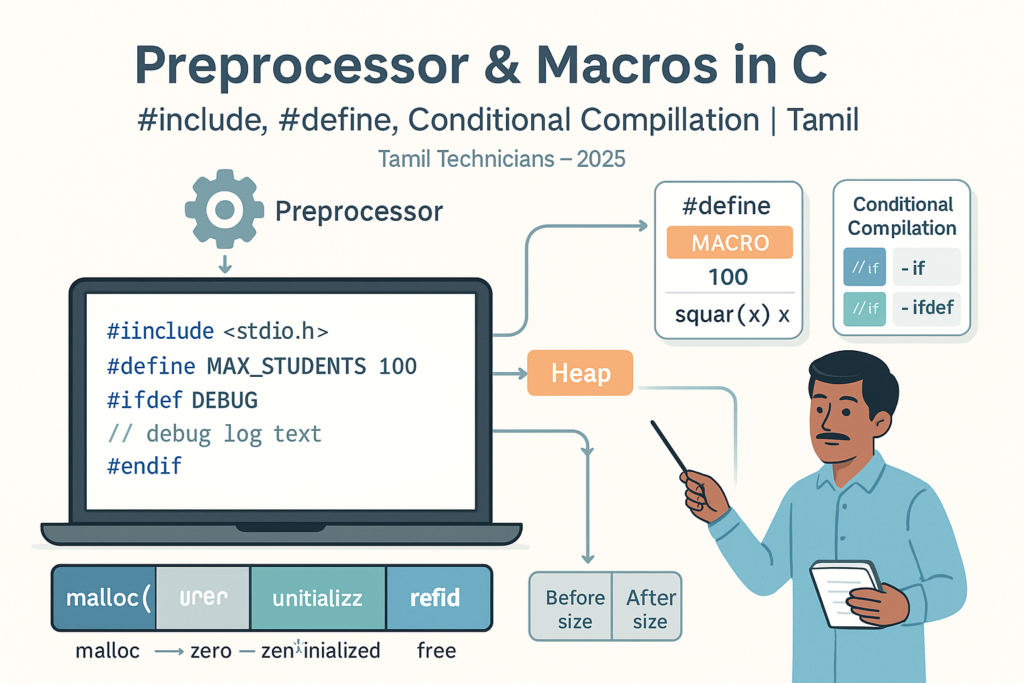
Preprocessor & Macros in C – #include, #define, Conditional Compilation
Preprocessor & Macros in C – #include, #define, Conditional Compilation | Tamil Technicians Tamil Technicians…

Dynamic Memory Allocation – malloc(), calloc(), realloc(), free() Basics
Dynamic Memory Allocation in C – malloc(), calloc(), realloc(), free() Basics | Tamil Technicians Tamil…
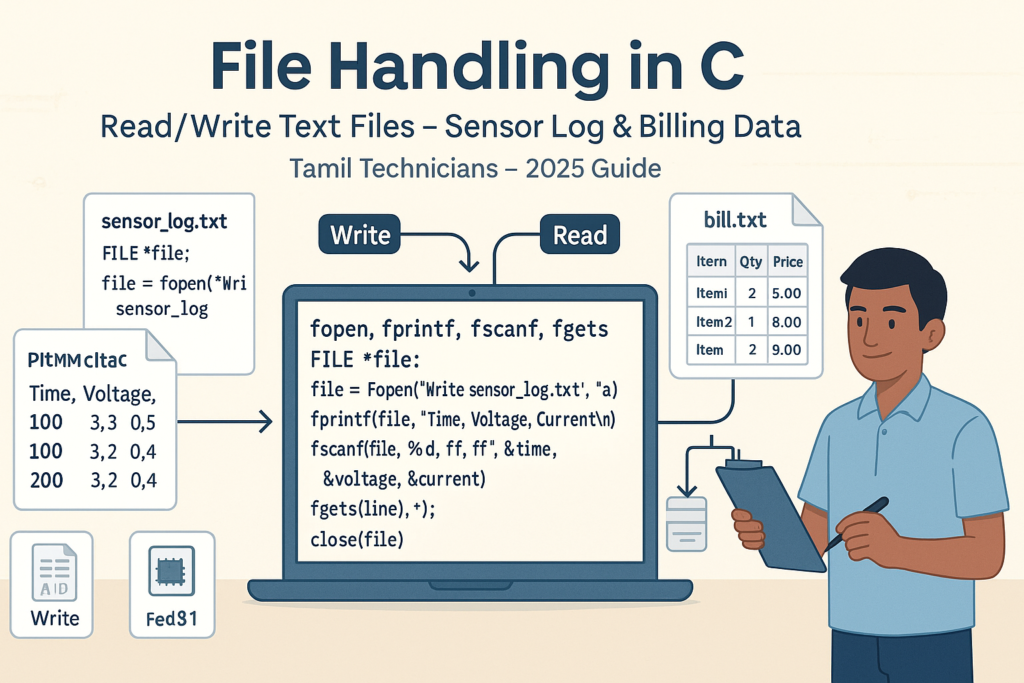
File Handling in C – Read/Write Text Files (Sensor Log, Billing Data Examples) 2025
File Handling in C – Read/Write Text Files (Sensor Log, Billing Data Examples) | Tamil…
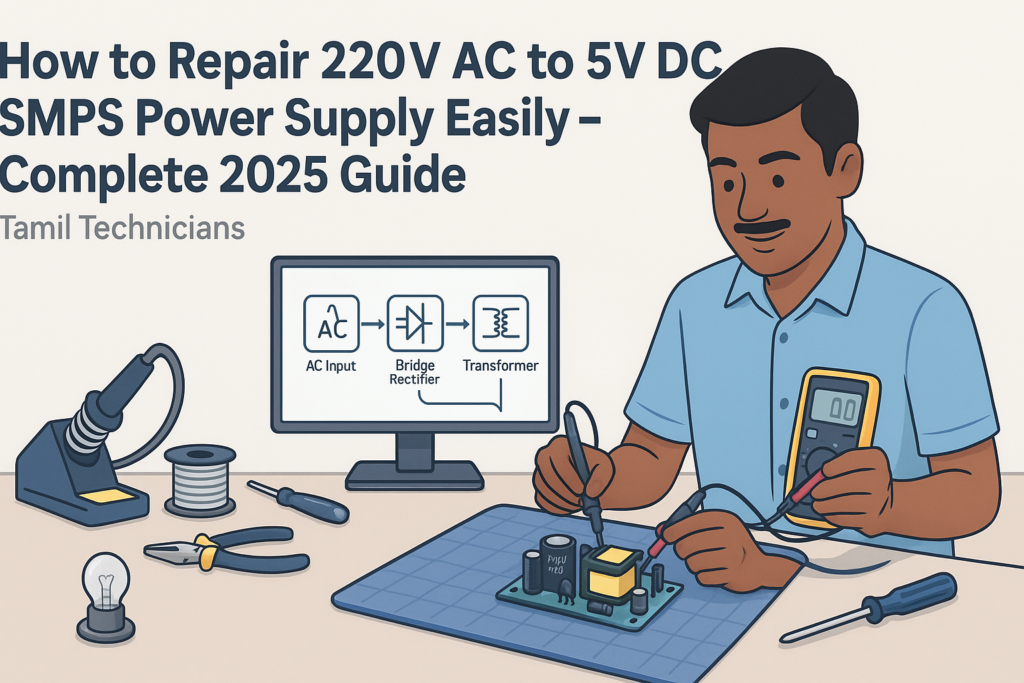
How to Repair 220V AC to 5V DC SMPS Power Supply Easily – Complete 2025 Guide
How to Repair 220V AC to 5V DC SMPS Power Supply Easily – Complete 2025…
How to Assemble a 5.1 Amplifier Easily – Complete 2025 Guide
How to Assemble a 5.1 Amplifier Easily (2025 Full Guide) | Tamil Technicians English How…
Top 10 Secrets in CRT TV Service in 2025
Top 10 Secrets in CRT TV Service in 2025 (Professional Technician Guide) CRT TV Service…
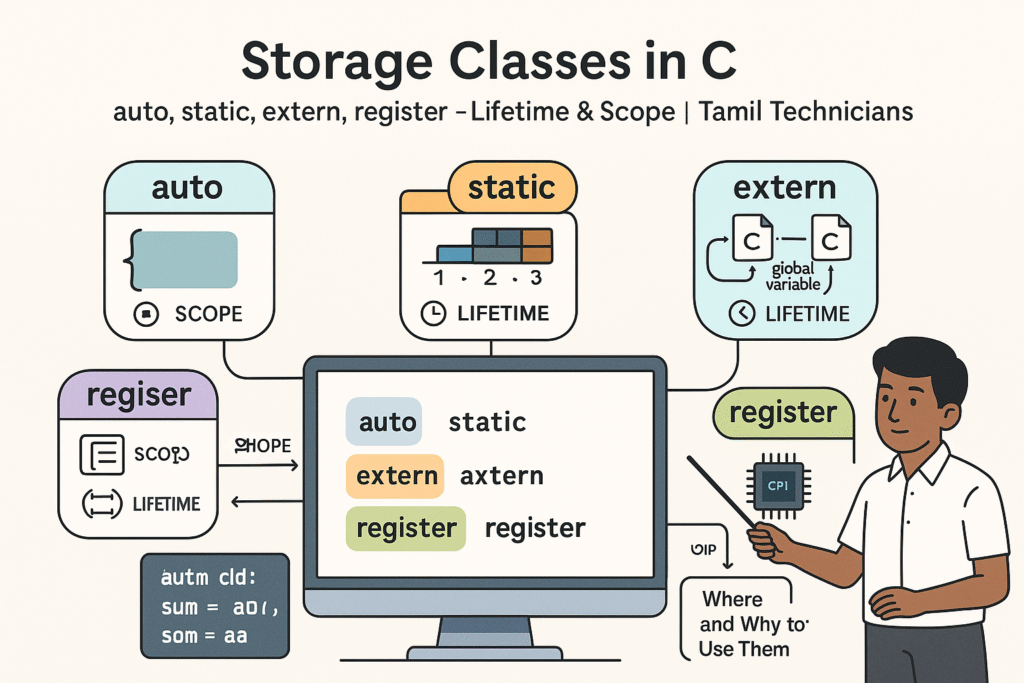
Storage Classes in C – auto, static, extern, register (Lifetime & Scope)
Storage Classes in C – auto, static, extern, register (Lifetime & Scope) | Tamil Technicians…

Structures in C – Struct with Examples (Student, Product, Device Data)
Structures in C – Struct with Examples (Student, Product, Device Data) | Tamil Technicians Tamil…
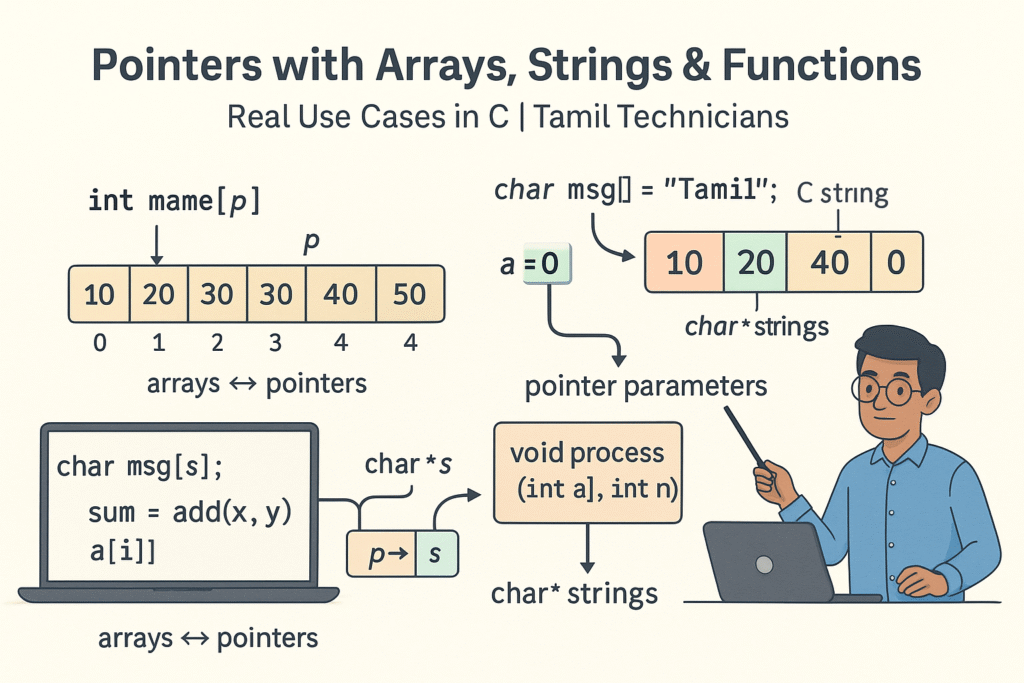
Pointers with Arrays, Strings & Functions – Real Use Cases
Pointers with Arrays, Strings & Functions – Real Use Cases | Tamil Technicians Tamil Technicians…
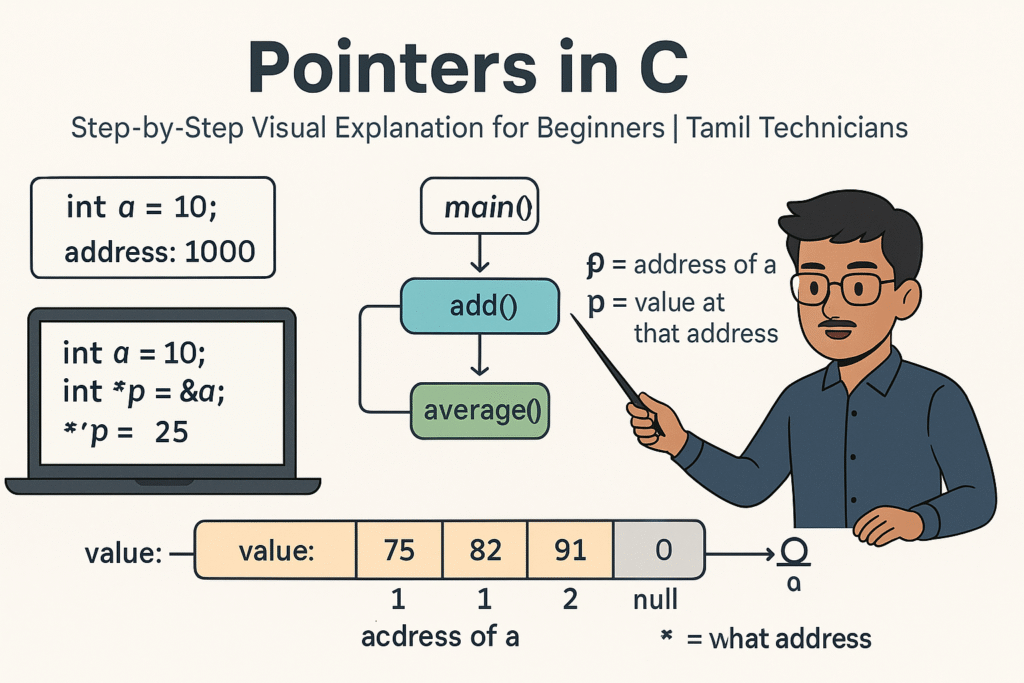
Pointers in C – Step-by-Step Visual Explanation for Beginners
Pointers in C – Step-by-Step Visual Explanation for Beginners | Tamil Technicians Tamil Technicians –…
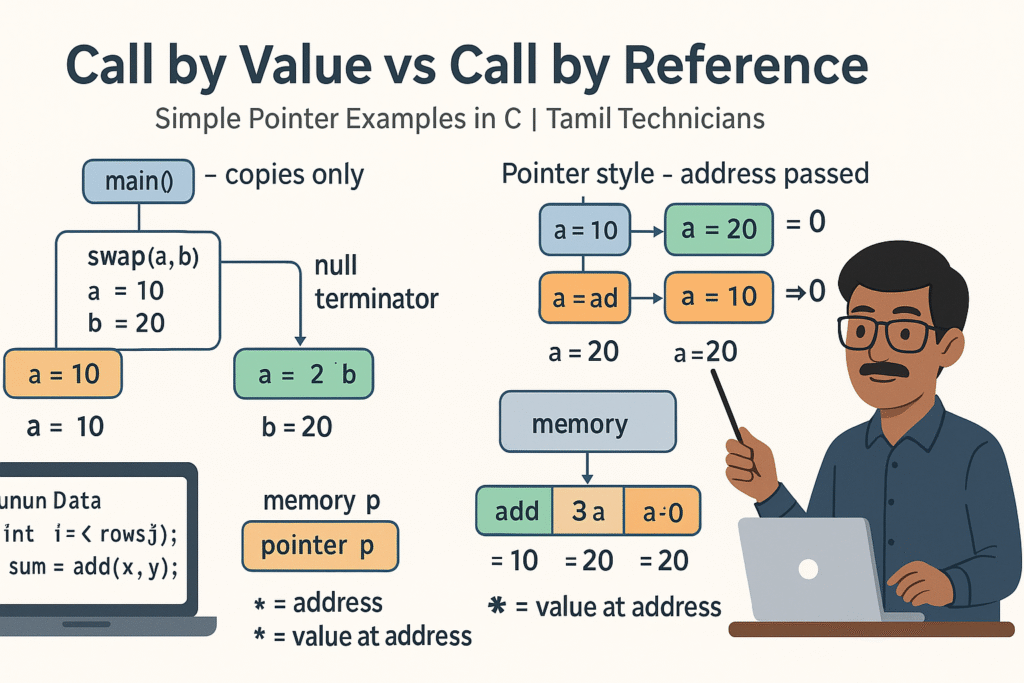
Call by Value vs Call by Reference – Simple Pointer Examples in Tamil
Call by Value vs Call by Reference – Simple Pointer Examples in Tamil | Tamil…
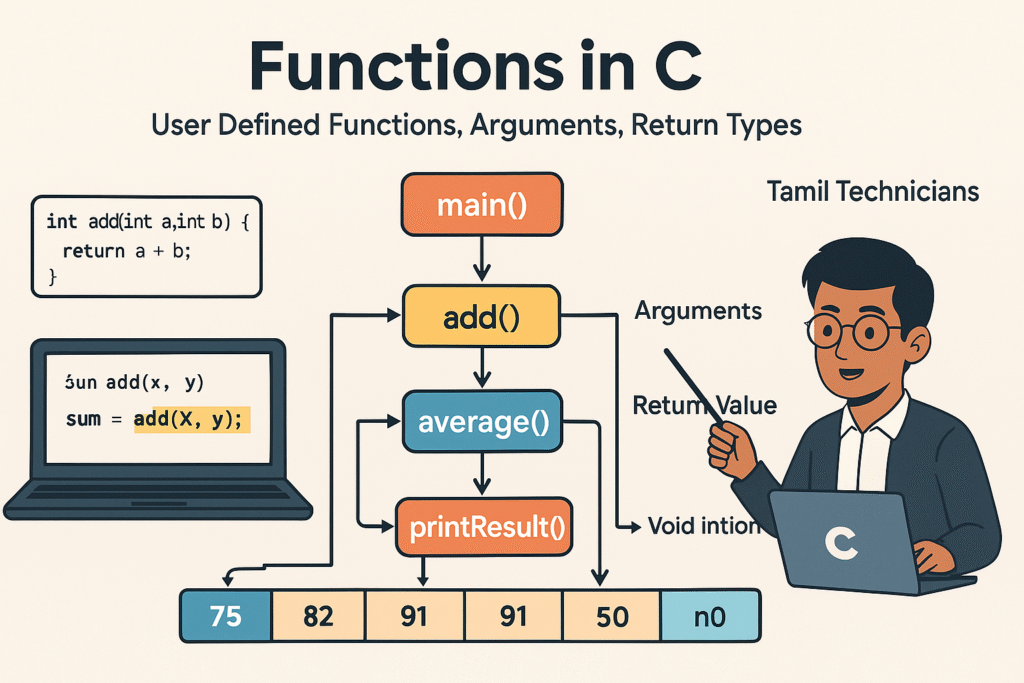
Functions in C – User Defined Functions, Arguments, Return Types
Functions in C – User Defined Functions, Arguments, Return Types | Tamil Technicians Tamil Technicians…
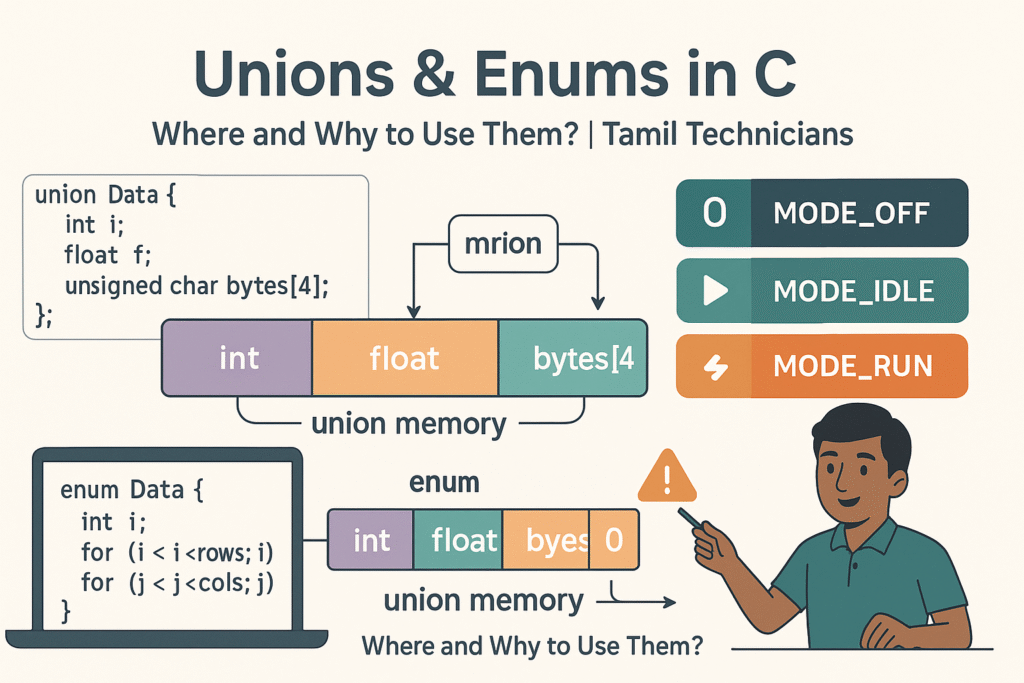
Unions & Enums in C – Where and Why to Use Them?
Unions & Enums in C – Where and Why to Use Them? | Tamil Technicians…
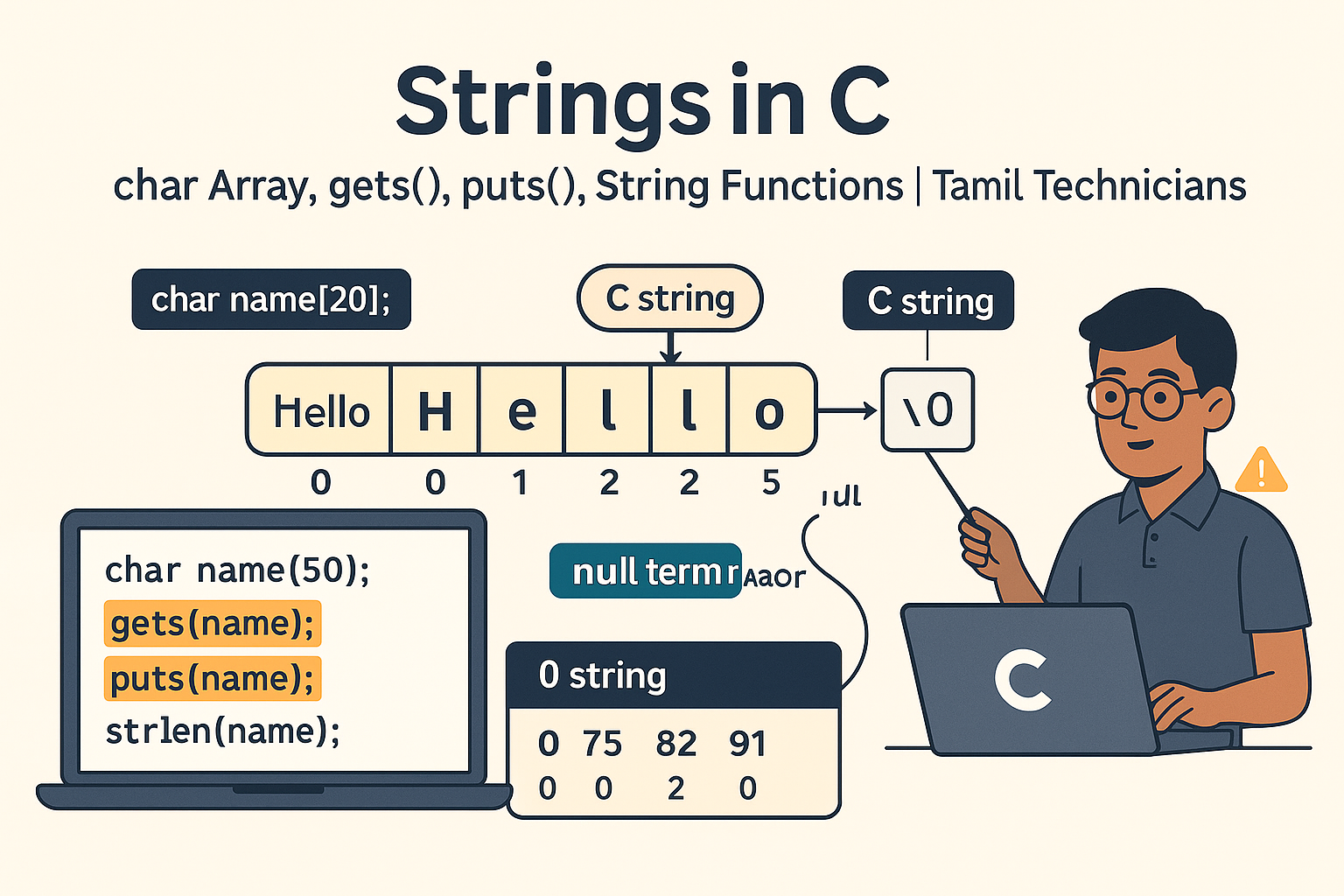
Strings in C – char Array, gets(), puts(), String Functions (strlen, strcpy, etc.)
Strings in C – char Array, gets(), puts(), String Functions (strlen, strcpy, etc.) | Tamil…
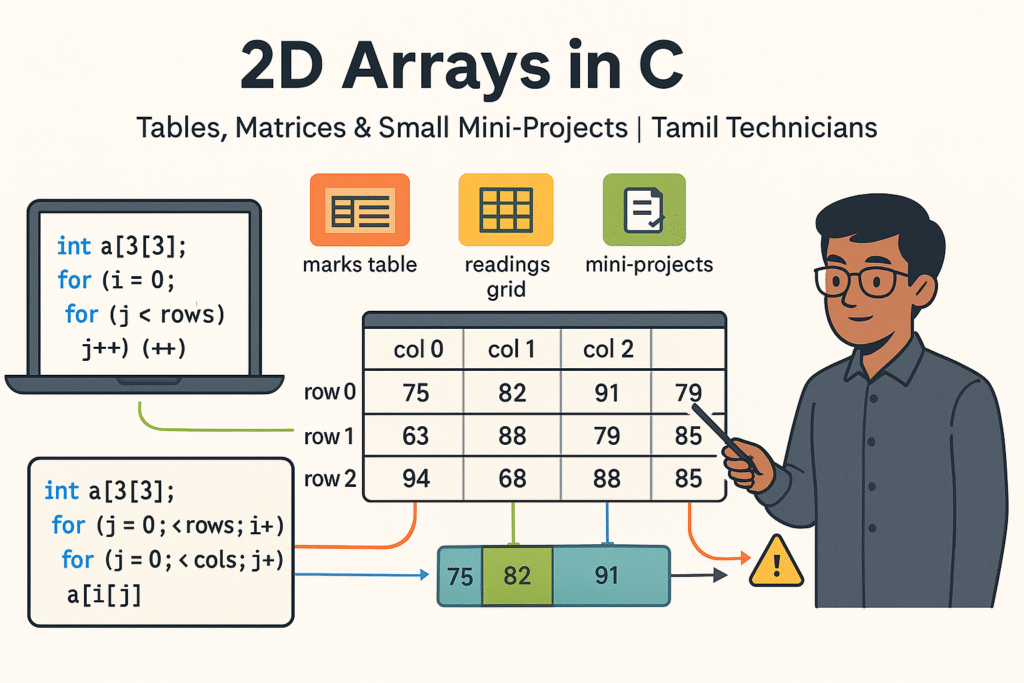
2D Arrays in C – Tables, Matrices & Small Mini-Projects
2D Arrays in C – Tables, Matrices & Small Mini-Projects | Tamil Technicians Tamil Technicians…
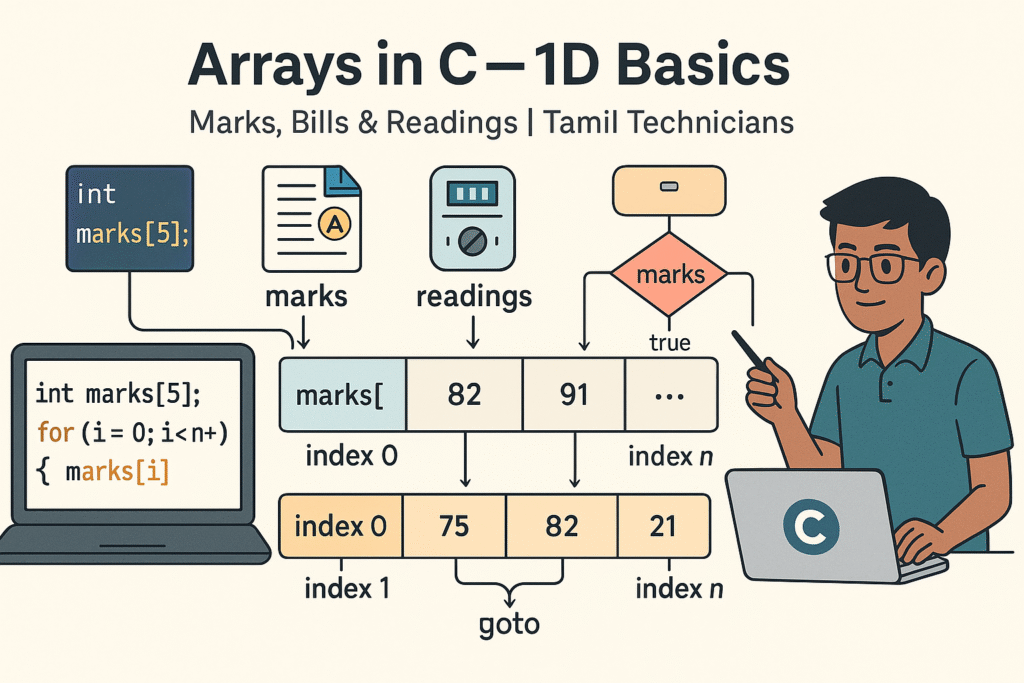
Arrays in C – 1D Array Basics with Practical Examples (Marks, Bills, Readings)
Arrays in C – 1D Array Basics with Practical Examples (Marks, Bills, Readings) | Tamil…
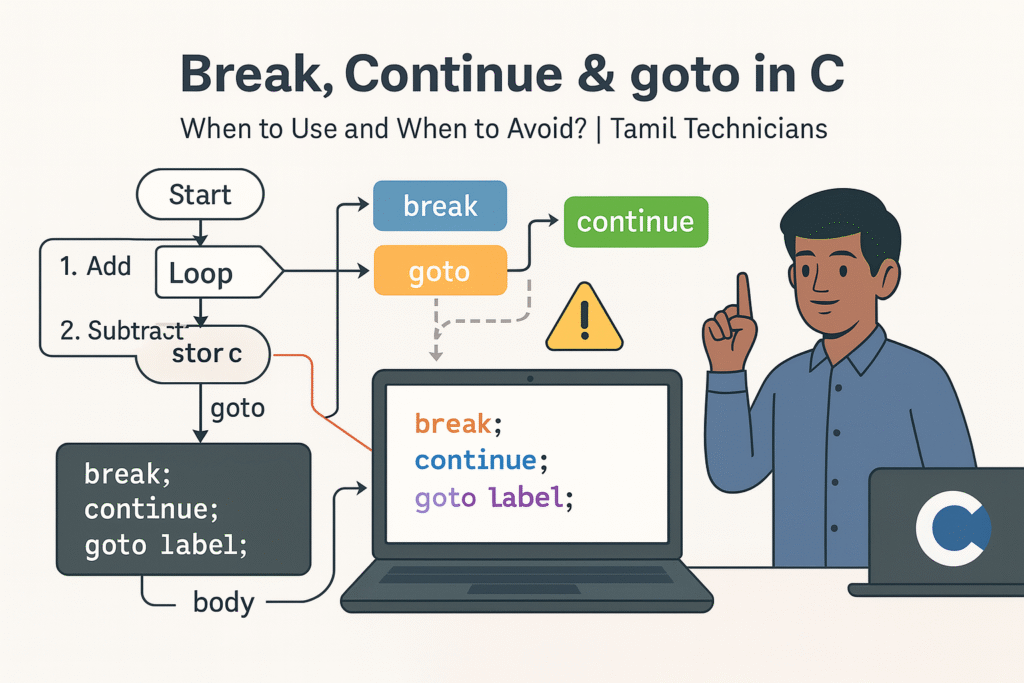
Break, Continue & goto in C – When to Use and When to Avoid?
Break, Continue & goto in C – When to Use and When to Avoid? |…

Loops in C – for, while, do-while Complete Guide (Patterns & Practice)
Loops in C – for, while, do-while Complete Guide (Patterns & Practice) | Tamil Technicians…
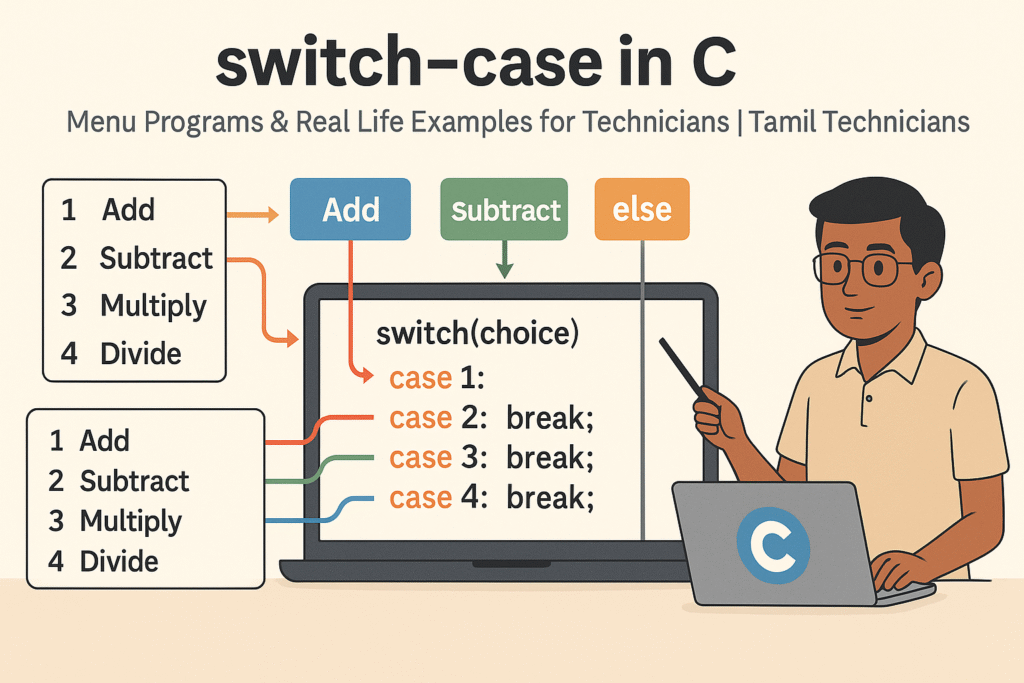
switch–case in C – Menu Programs & Real Life Examples for Technicians
switch–case in C – Menu Programs & Real Life Examples for Technicians | Tamil Technicians…
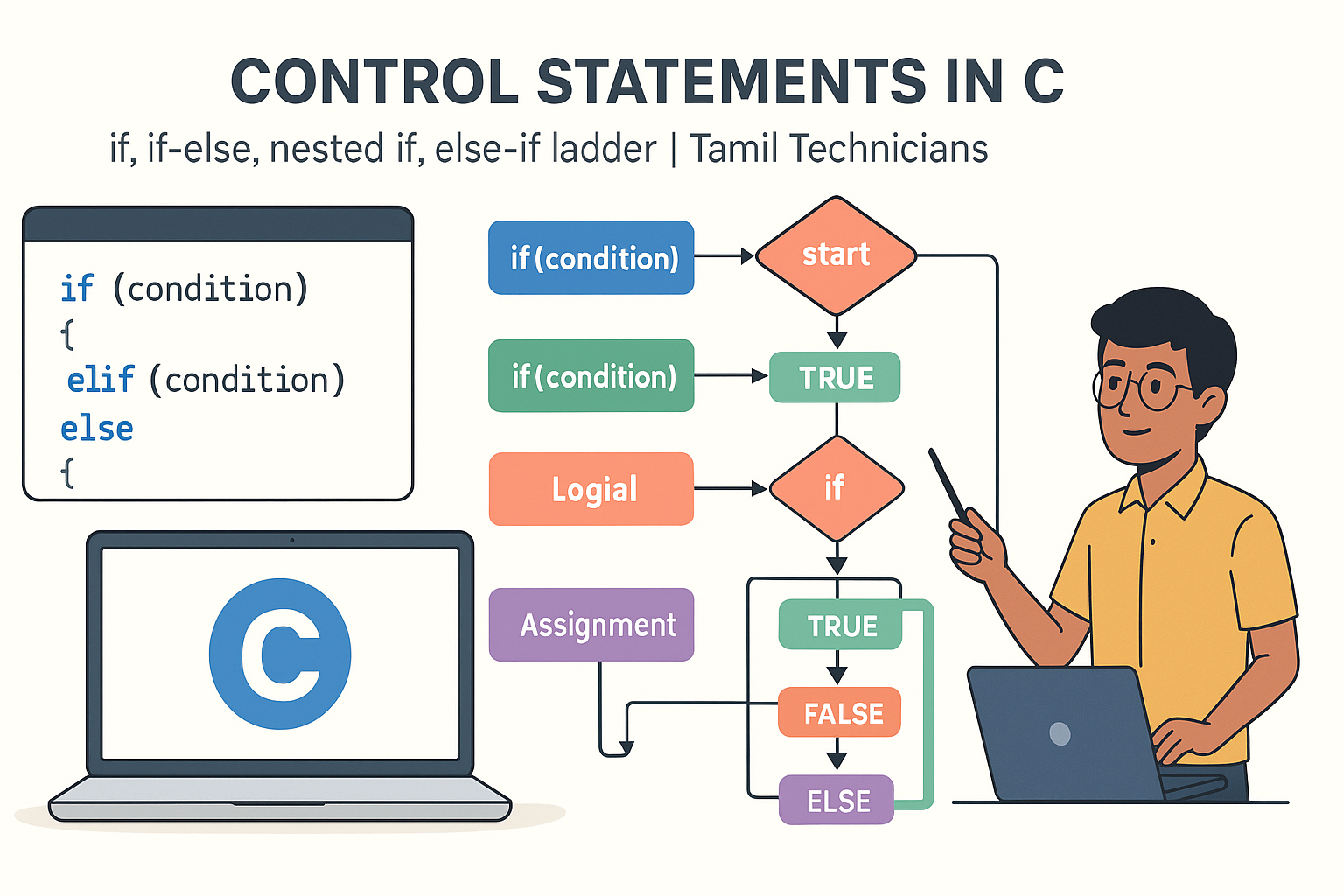
Control Statements in C – if, if-else, nested if, else-if ladder (Tamil Explanation)
Control Statements in C – if, if-else, nested if, else-if ladder (Tamil Explanation) | Tamil…
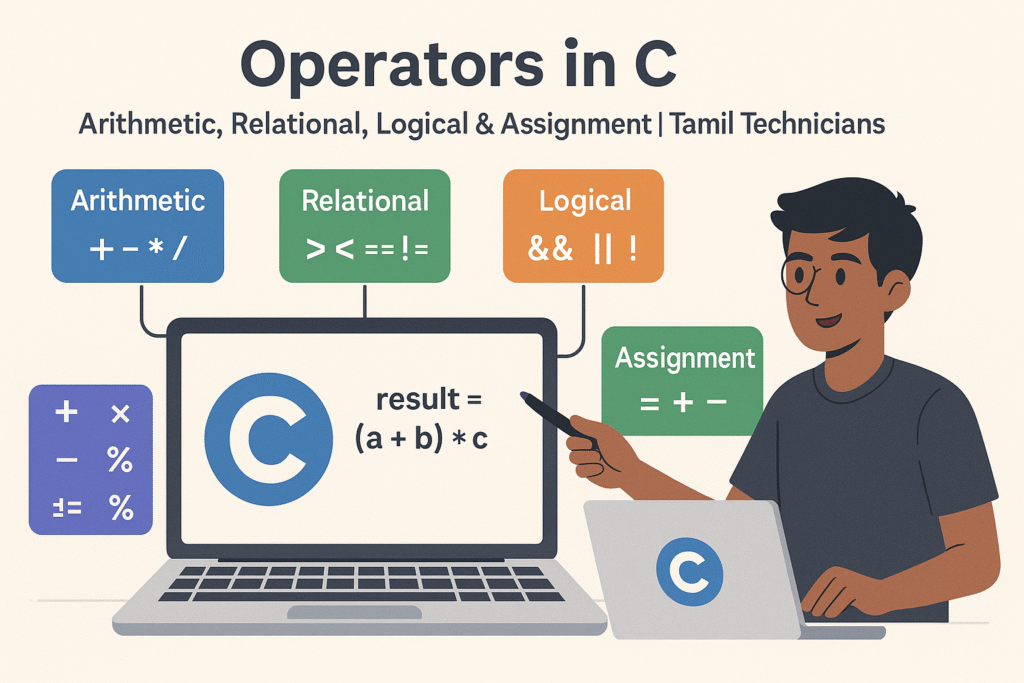
Operators in C – Arithmetic, Relational, Logical & Assignment (with Examples)
Operators in C – Arithmetic, Relational, Logical & Assignment (with Examples) | Tamil Technicians Tamil…